01 / Paper overview
Abstract
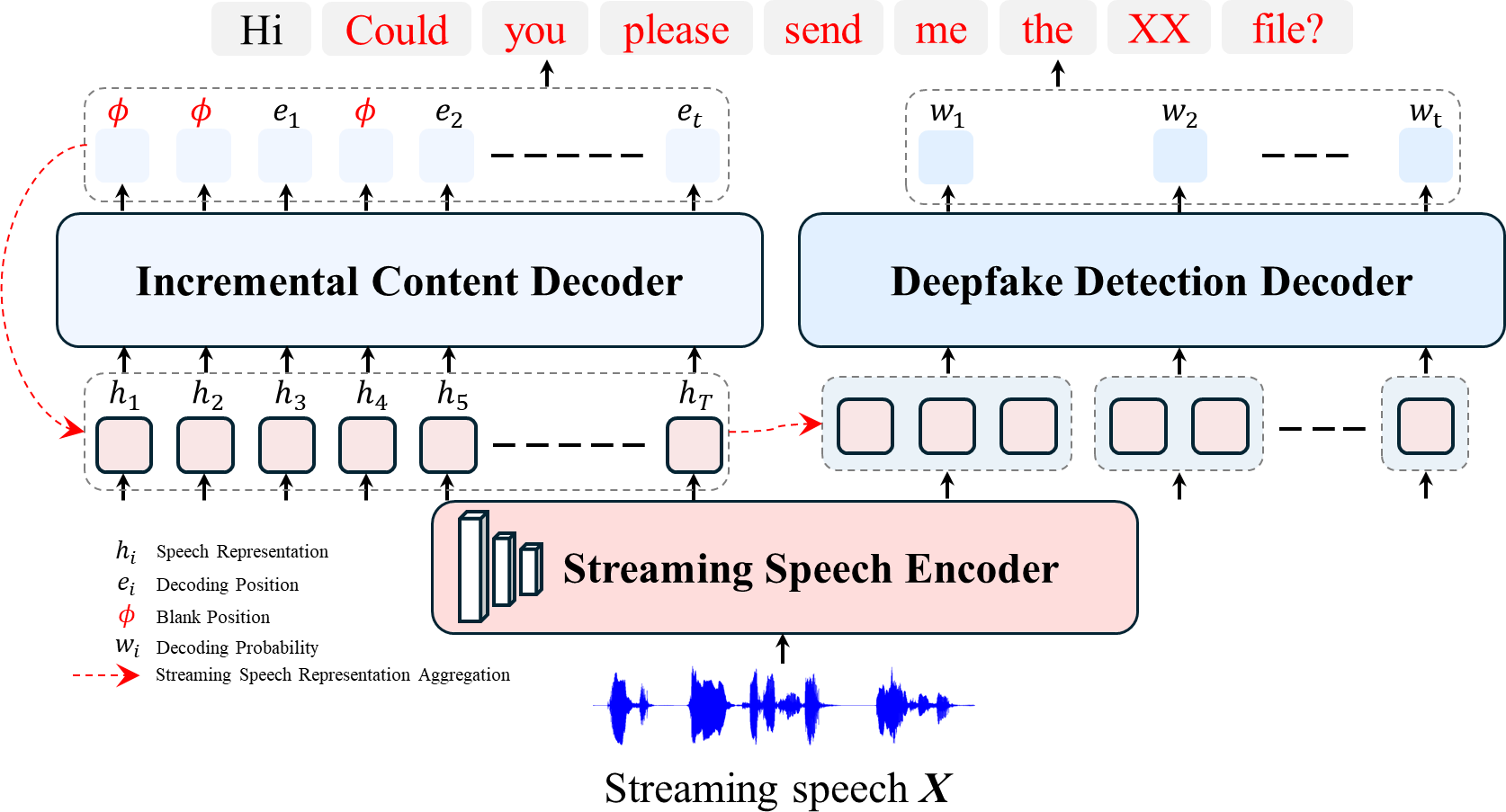
Speech synthesis has made voice interaction increasingly convenient, but has also heightened the risk of voice fraud. In real-time communication scenarios such as online meetings, speech deepfakes can directly influence decision-making and cause financial losses. However, existing detection methods have yet to systematically address the requirements of speech deepfake detection in real-time communication, such as streaming speech processing, real-time responsiveness, and robustness to transmission distortions. In this paper, we propose StreamFake, a low-overhead and robust framework for word-level streaming speech deepfake detection in real-time communication. We observe that streaming automatic speech recognition is already widely deployed in real-time communication and that its encoder produces rich discriminative representations. Further analysis shows no substantial optimization conflict between speech recognition and deepfake detection. Based on these insights, we unify the two tasks within a streaming framework. Specifically, StreamFake reuses the streaming encoder, aggregates word-level acoustic representations according to the temporal boundaries emitted by the content decoder, and performs synchronous authenticity classification using a lightweight detection decoder. This design introduces only 0.22M additional parameters without degrading the original speech recognition performance. Extensive experiments show that StreamFake achieves state-of-the-art performance under low-latency settings. It also consistently outperforms existing baselines on black-box voice-cloning APIs and in real-world communication environments, further demonstrating its practical value.